The two degrees that decide everything
Why 2 to 8°C is less a rule than a margin of safety, and what freezing quietly does to a vial that still looks perfect.
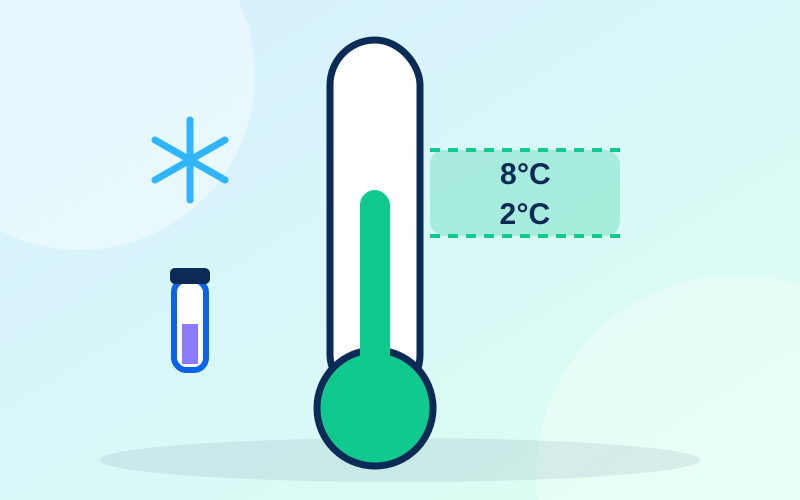
Picture a dispensary on a Monday morning. The vaccine fridge display says 5°C, the nurse nods, and the day begins. It feels settled. But that number is one reading, from one spot, at one moment. What happened at 3 a.m. on a cold shelf near the back wall is a different story, and the vials will not tell you.
A range with two cliffs
Most refrigerated vaccines are kept between 2 and 8°C. People tend to remember the 8, because heat is the obvious enemy. The 2 matters just as much. Vaccines built with an aluminium adjuvant are freeze-sensitive: once they freeze, the potency lost can never be restored, and freeze-damaged doses are more likely to cause local reactions such as sterile abscesses.1
A frozen vial does not look damaged. That is exactly what makes freezing so dangerous.
How often does it really happen?
More often than most of us would guess. A 2007 systematic review in the journal Vaccine, summarised by PATH's Optimize project, found that between 35 and 70 percent of vaccine is exposed to freezing temperatures at some point on its journey.2 Closer to home, Kenya's cold chain review linked a facility freeze excursion rate of 3.5 percent partly to gas-powered absorption fridges that lack freeze protection.3
Take the suspect vial and a control vial from the same batch. Freeze the control solid, let it thaw, then shake both and watch how fast the contents settle. If the suspect vial clears as quickly as the control, freezing is the likely culprit. In the 2010 WHO Bulletin study of 475 vials covering 8 vaccine types from 10 manufacturers, the test matched laboratory microscopy every time.1 It is meant for aluminium-adsorbed vaccines only, and your national immunisation guidelines always come first.
What this changes when you buy equipment
If you only remember one thing, make it this: a fridge for vaccines is judged by what it prevents, not just how cold it gets. Kenya's programme describes the best-in-class approach as freeze protection that works without anyone having to do anything.3 Pair that with a buffered probe, an alarm and a display you can read without opening the door, and the 3 a.m. problem starts to disappear.
Not sure which fridge fits your clinic? Browse our equipment catalogue or ask us directly.
Talk to us about your site, your stock and your budget.
Ask Medix WhatsAppSources
- Kartoglu U, et al. Validation of the shake test for detecting freeze damage to adsorbed vaccines. Bulletin of the World Health Organization, 2010;88(8):624-631. scielosp.org ↗
- PATH and Gavi, Optimize project. The need for ongoing innovation in vaccine cold chain equipment (cites Vaccine 2007;25(20):3980-3986). www.technet-21.org ↗
- SEforALL and CHAI. Chilling Prospects 2022: Expanding the vaccine cold chain in Kenya through innovative cooling solutions. www.seforall.org ↗